Phase A · neuroscience battery

A8 · Whole-state recording

cf. Jonas & Kording 2017

← back to the method catalogue

What it does?

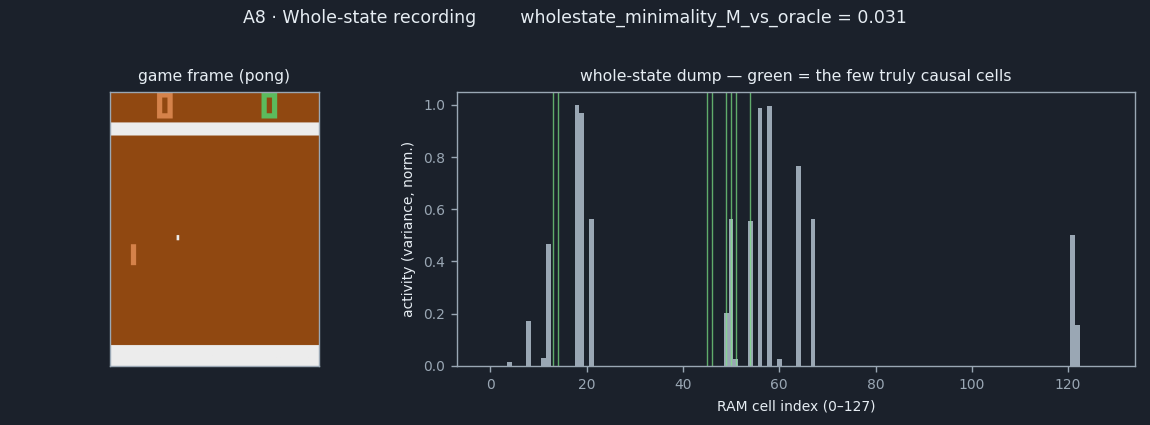
Whole-state recording is the simplest possible method: write down everything. At each step we record every bit of RAM and every register, the complete internal state over time. This is the raw material that every other method in the study works from. In neuroscience it is the dream of recording every neuron at once, and it is often treated as the thing that would finally let us understand the system. The intuition is that if we have the full state, we have hidden nothing, so we must have the explanation. We include it as a deliberate baseline to test that intuition. By construction the complete record is perfectly faithful and perfectly sufficient: it contains every cause, so nothing is missing, and it can predict any intervention because it holds the whole machine. The point of including it is to show what such a record still lacks. A dump of all 128 RAM cells is not an account of the computation. It names everything, so it names nothing in particular, and the true cause of any given output is a tiny handful of those cells. Completeness is not understanding, and this method makes that concrete.

A8 · Whole-state recording result

Left: the frame. Right: this method's per-cell/per-component result against the ground-truth importance, with the RAM cells labelled. wholestate_minimality_M_vs_oracle = 0.031 — this example only (pong, state gameplay(seed=0,prefix=90)+15); the audit aggregate is below.

How it's scored

The score that matters for this method is minimality, not faithfulness. Recording the whole state is perfectly faithful, because it contains every cause, and perfectly sufficient, because it holds the whole machine and can predict any intervention. So F and S are both at the ceiling by construction. Minimality is defined as the size of the true minimal cause set divided by the size of the set the explanation names. The whole-state dump names all 128 RAM cells, while the true cause of any output is a handful of them, so the ratio is tiny and the minimality is very low. That is the whole point of including this baseline: a complete record is faithful and sufficient yet says nothing in particular, because it withholds nothing. The grading is always against the intervention oracle, which supplies the true minimal set. There is no sprite-position hard-case here; the method makes no positional claim. The audit box reports the exact per-axis triad, F, S, and M, read straight from the leaderboard, so you can see faithfulness and sufficiency at the ceiling beside a minimality near the floor.

The score is measured against the §1 intervention oracle — never against another interpretability method. F (faithful) is always vs the oracle; see the execution stack. How each of F / S / M is actually computed for this method (and whether it matches the paper) is in the box just below; the numbers are in the In the audit box under it.
How F, S, M are computed here

The exact formula this method uses for each score, read from its runner, and whether it matches the paper's §3 (F ∧ S ∧ M triad) definition. From the committed audit fsm_math_phaseA.json.

AxisFormula (as computed) What it measuresMatches §3?
F
faithfulness
\(F = \mathrm{recall}\!\left(U^{\star}\mid \hat{U}=\text{whole state}\right) = 1\)Recall of the oracle-causal cells under the record-everything map; trivially 1.0 because the whole state includes every cell.◐ partial Scored vs the oracle causal cells but the primitive is recall (not the correlation/edge-F1 the paper specifies); it is a hard-coded 1.0 by construction, consistent with the paper's 'trivially faithful' whole-state baseline. Runner A8_wholestate.jl,; record out/A8_pong.json triad.F=1.0.
how it's measured — call stack:
  1. whole state names every cell ⇒ recall of oracle-causal cells = 1 — A8_wholestate.jl:561
  2. true causal effect Δy(u) by bit-exact re-run — oracle_intervene.jl:242
S
sufficiency
\(S = \mathbb{1}\!\left[\text{restored 128-byte RAM} = \text{exact RAM + frame}\right] \in \{0,1\}\)1 if the recorded whole 128-byte RAM state, restored, reproduces the exact RAM and frame (lossless), else 0.✓ matches Literal sufficiency: the recorded whole 128-byte RAM state, restored, reproduces the exact RAM and frame (bit-exact re-run). §3 (sec:triad) admits the [0,1] fraction-within-tolerance special case of the held-out test; this boolean 1/0 hit is that special case at its extreme. A8_wholestate.jl; record S=1.0.
how it's measured — call stack:
  1. lossless check: restored 128-byte RAM == exact RAM — A8_wholestate.jl:399
  2. S folded into the triad record — A8_wholestate.jl:565
  3. true causal effect Δy(u) by bit-exact re-run — oracle_intervene.jl:242
M
minimality
\(M = |U^{\star}| / |\hat{U}| = n_{\mathrm{causal}} / 128\)Number of oracle-causal cells over the size of the named set (128), the whole-state minimality floor.✓ matches The only Phase-A method whose M is exactly |U*|/|U_hat|; paper cites whole-state M=0.07. Headline metric_name = wholestate_minimality_M_vs_oracle. A8_wholestate.jl,; record out/A8_pong.json M=0.03125 = 4/128.
how it's measured — call stack:
  1. M = |oracle-causal cells| / 128 (whole-state floor) — A8_wholestate.jl:563
  2. true causal effect Δy(u) by bit-exact re-run — oracle_intervene.jl:242

✓ matches = the same quantity as §3; ◐ partial = the same kind of estimator but a differing detail; ✗ does not match = a different quantity (see the note). Definitions: F = agreement with the oracle's true causal effects Δy(u); S = held-out predictive score in [−1, 1]; M = |U*|/|Û| (true-minimal-set size / named-set size).

In the audit

This is the method's entry in the actual cross-method audit — scored on the paper's correctness triad, each axis a mean over all 42 scored games (42 committed §R records), not the single example shown above. Tradition: descriptive. The example figure (Pong) is one of those records.

1.000F — faithfulness vs oracle (mean over 42 games, ±0.000 CI95)
1.000S — sufficiency: held-out predictive (n/a where the paper does not define this axis)
0.075M — minimality: true-minimal-set / named-set (n/a otherwise)
42committed records aggregated
0.00human-plausibility proxy

F faithfulness (scored vs the oracle for every method) · S sufficiency (held-out predictive score in [−1, 1]; a negative value means the explanation predicts held-out interventions worse than the unperturbed baseline; reported for the predictive methods across all three phases where the calibration/held-out split is defined) · M minimality (true-minimal-set / named-set; where the method names a cause set) — n/a otherwise, per the paper's F ∧ S ∧ M triad.

Source: leaderboard.json · the whole leaderboard is on the methods page and the Paper 2 audit.

Results per game

This method's faithfulness on each of the 42 scored games (all-regime F; this method has no content-vs-position split (see the note below)). Click a header to sort. Every number is read from site_data.json (methods.A8_wholestate.per_game).

content-F and position-F are n/a for this method. The content-vs-position split applies only to pixel-attribution methods — those that produce an attribution map over the framebuffer, whose score can be read separately on the smooth content outputs and the discrete position outputs (where the naive gradient is provably zero). This method does not attribute to a pixel output; it is graded by its own fidelity metric (wholestate_minimality_M_vs_oracle), reported as the F column, so there is no content or position regime to separate.

GameF (all)content-Fposition-FSMNote
Air Raid1.000n/an/a1.0000.078recovers the true causes
Alien1.000n/an/a1.0000.031recovers the true causes
Assault1.000n/an/a1.0000.070recovers the true causes
Atlantis1.000n/an/a1.0000.055recovers the true causes
Bank Heist1.000n/an/a1.0000.031recovers the true causes
Beam Rider1.000n/an/a1.0000.016recovers the true causes
Berzerk1.000n/an/a1.0000.109recovers the true causes
Bowling1.000n/an/a1.0000.062recovers the true causes
Boxing1.000n/an/a1.0000.070recovers the true causes
Breakout1.000n/an/a1.0000.055recovers the true causes
Carnival1.000n/an/a1.0000.117recovers the true causes
Centipede1.000n/an/a1.0000.055recovers the true causes
Chopper Command1.000n/an/a1.0000.078recovers the true causes
Demon Attack1.000n/an/a1.0000.070recovers the true causes
Double Dunk1.000n/an/a1.0000.094recovers the true causes
Fishing Derby1.000n/an/a1.0000.039recovers the true causes
Freeway1.000n/an/a1.0000.109recovers the true causes
Frostbite1.000n/an/a1.0000.109recovers the true causes
Gopher1.000n/an/a1.0000.148recovers the true causes
Hero1.000n/an/a1.0000.086recovers the true causes
Ice Hockey1.000n/an/a1.0000.070recovers the true causes
Jamesbond1.000n/an/a1.0000.055recovers the true causes
Kangaroo1.000n/an/a1.0000.078recovers the true causes
Krull1.000n/an/a1.0000.086recovers the true causes
Kung-Fu Master1.000n/an/a1.0000.047recovers the true causes
Montezuma's Revenge1.000n/an/a1.0000.102recovers the true causes
Ms. Pac-Man1.000n/an/a1.0000.109recovers the true causes
Name This Game1.000n/an/a1.0000.031recovers the true causes
Pacman1.000n/an/a1.0000.055recovers the true causes
Phoenix1.000n/an/a1.0000.062recovers the true causes
Pitfall1.000n/an/a1.0000.086recovers the true causes
Pong1.000n/an/a1.0000.031recovers the true causes
Private Eye1.000n/an/a1.0000.094recovers the true causes
Q*bert1.000n/an/a1.0000.055recovers the true causes
Riverraid1.000n/an/a1.0000.148recovers the true causes
Road Runner1.000n/an/a1.0000.047recovers the true causes
Seaquest1.000n/an/a1.0000.117recovers the true causes
Space Invaders1.000n/an/a1.0000.094recovers the true causes
Tennis1.000n/an/a1.0000.086recovers the true causes
Venture1.000n/an/a1.0000.125recovers the true causes
Video Pinball1.000n/an/a1.0000.055recovers the true causes
Yars' Revenge1.000n/an/a1.0000.055recovers the true causes

Call stack — how it runs on jutari / jaxtari

The path from this method's runner (run_game) into the bit-exact VCS substrate, and the computation it involves. Every step links to the exact source on main. From callstack_phaseA.json.

Applied on the substrate

  1. assemble the shared gameplay-state testbed + cause-density gate — build_a8_shared_state(game) -> build_shared_testbed(game; ...) runner
  2. build_shared_testbed definition: booted checkpoint + shared output + gate — function build_shared_testbed(game; ...) runner
  3. cause-density gate counts causes with |Delta_y|>floor via the oracle — cause_density = count(>(floor), deltas) runner
  4. boot the real ROM and replay to the target frame (runner-local boot_replay) — boot_replay(game, actions, target_frame) runner
  5. record the WHOLE state (128 RAM + 64 TIA) per frame across the trajectory — record_whole_state(game, actions) runner
  6. step the real emulator one frame per action while recording — env_step!(env, Int(actions[t])) jutari

The computation

  1. whole-state restore: write the full recorded 128-byte RAM back over the baseline checkpoint (the whole-state 'readout') — restore_whole_ram(checkpoint, ram) runner
  2. whole-state sufficiency (method under test): does restoring the ENTIRE recorded RAM reproduce the exact frame (RAM+screen) — verify_wholestate_sufficiency(checkpoint, at_target) runner
  3. minimal-set sufficiency (positive control): restore ONLY the oracle-causal cells and check the frame is reproduced (contrast that makes over-recording measurable) — verify_minimal_sufficiency(checkpoint, at_target, causal_idx) runner
  4. oracle-causal importance per cell (defines the minimal causal set) — oracle_causal_importance(checkpoint, tail, cands, at_target) runner

Scored against the exact intervention oracle Δy(u): run_intervention(checkpoint, actions, target_frame, horizon, cause).

Implementation
tools/xai_study/phaseA_kording/A8_wholestate.jl
Reference
cf. Jonas & Kording 2017
Record
A8_pong.json
All records
phaseA_kording/out

The figure is generated from the committed record by docs/gen_method_figures.py; the game frame and each RAM cell's screen footprint are produced by render_scenes.jl / cell_footprints.jl.