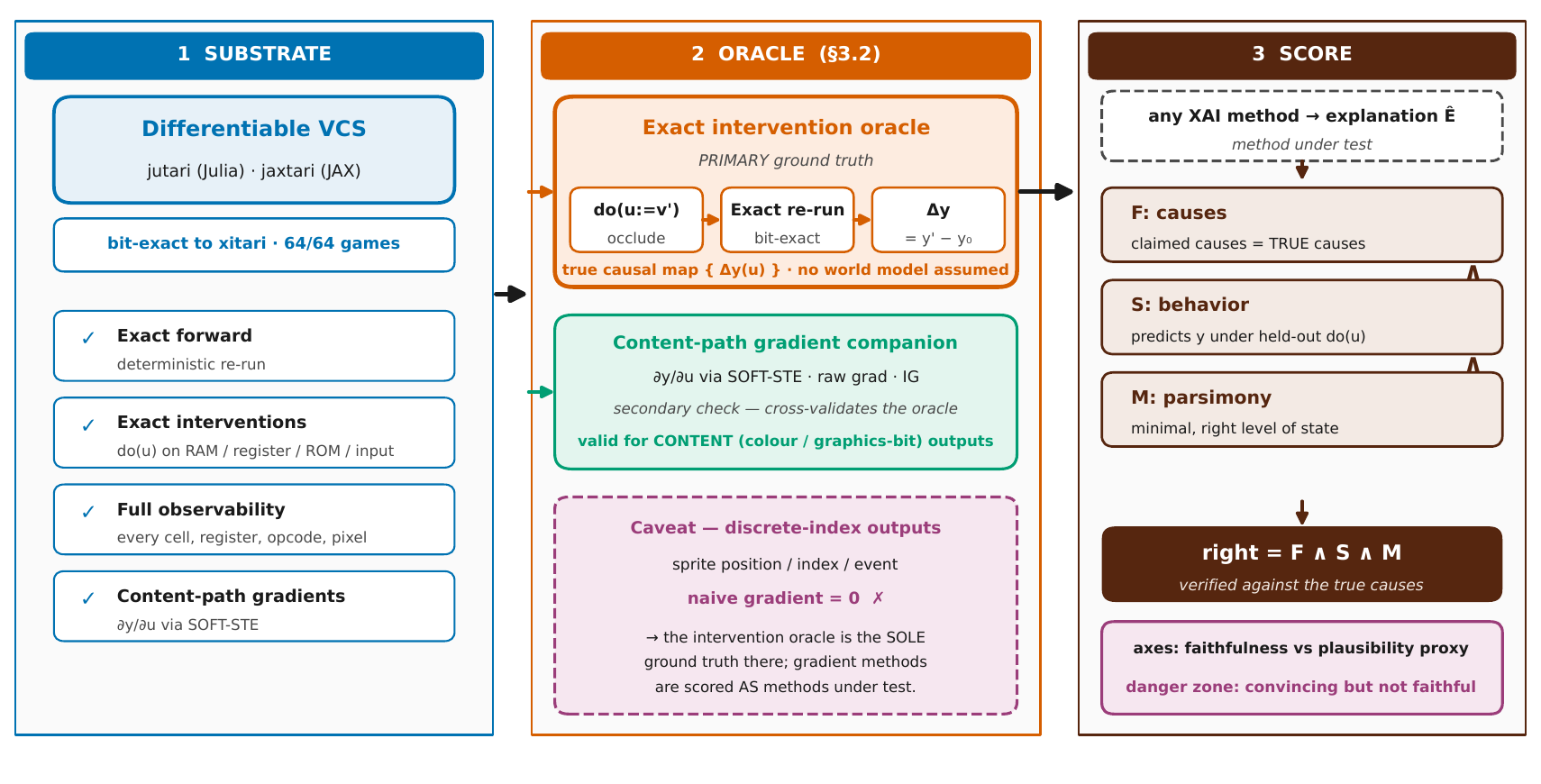
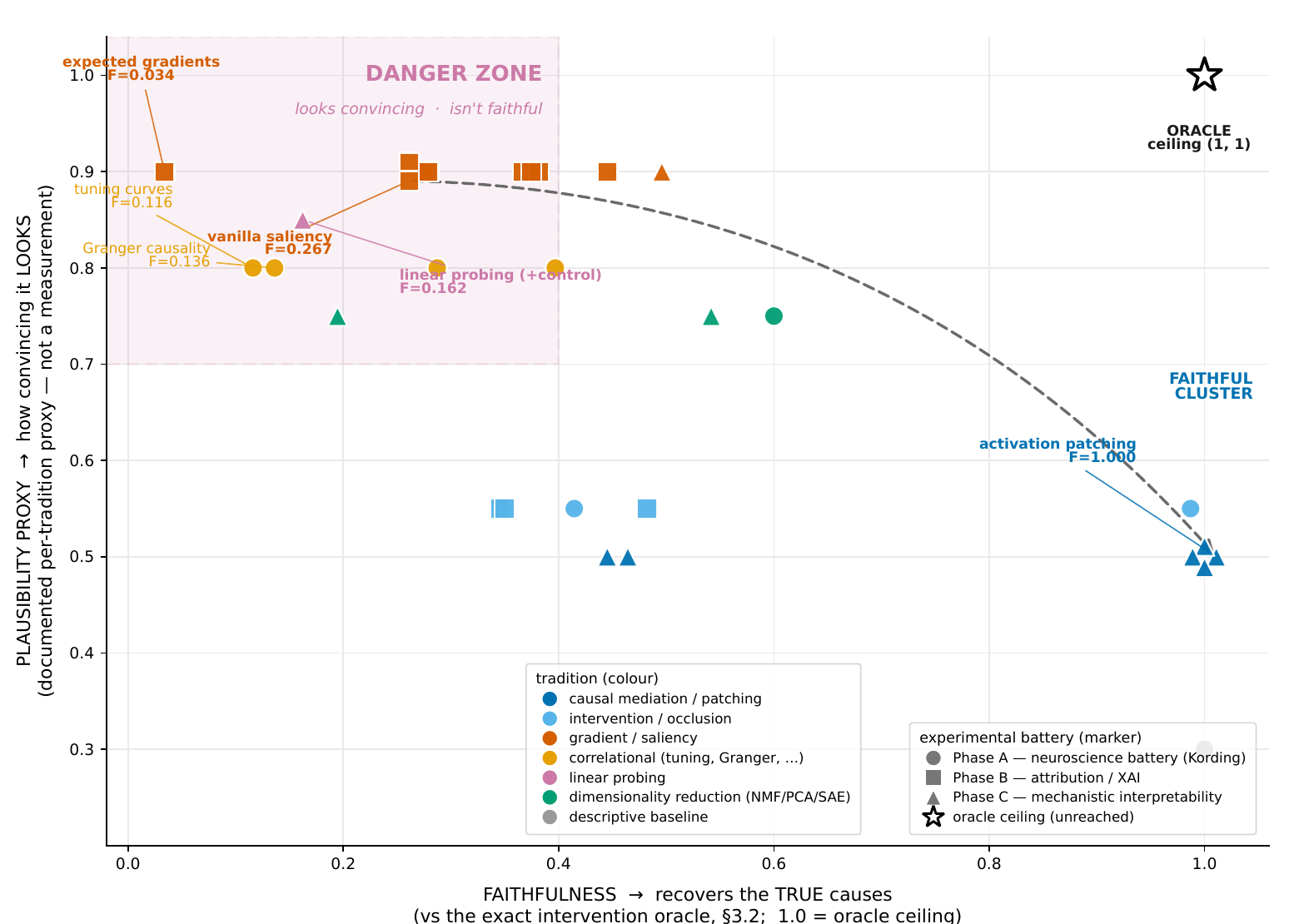
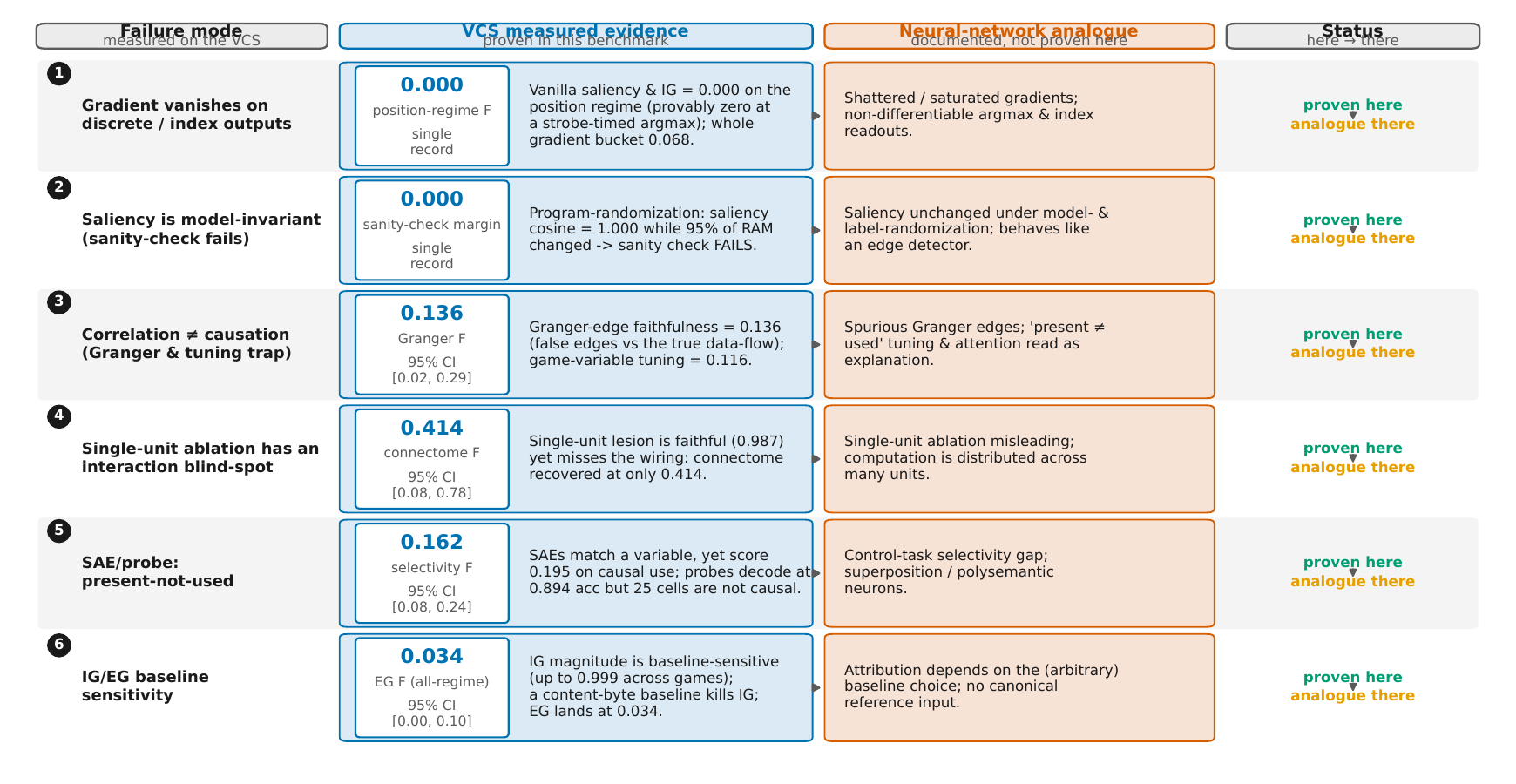
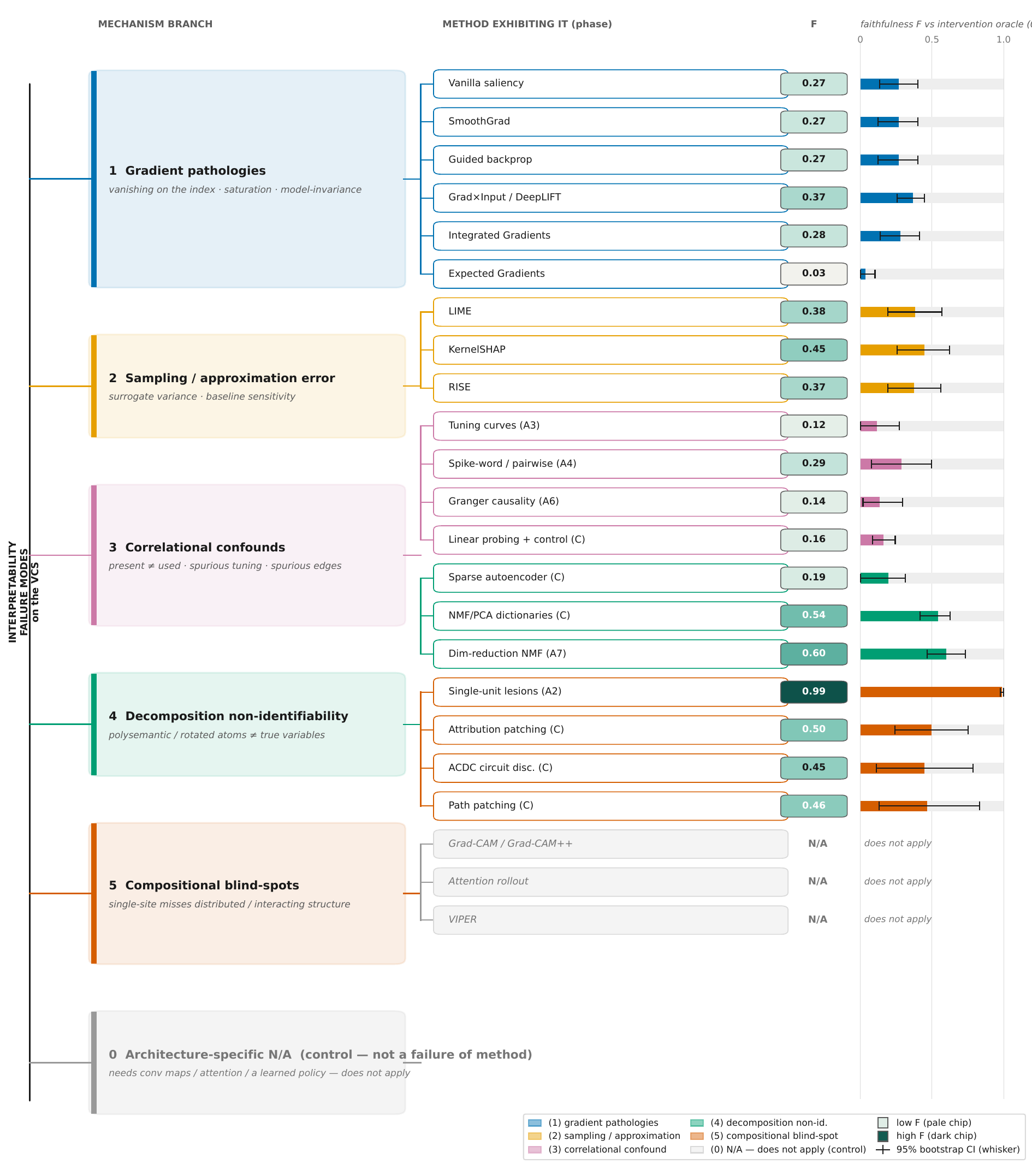
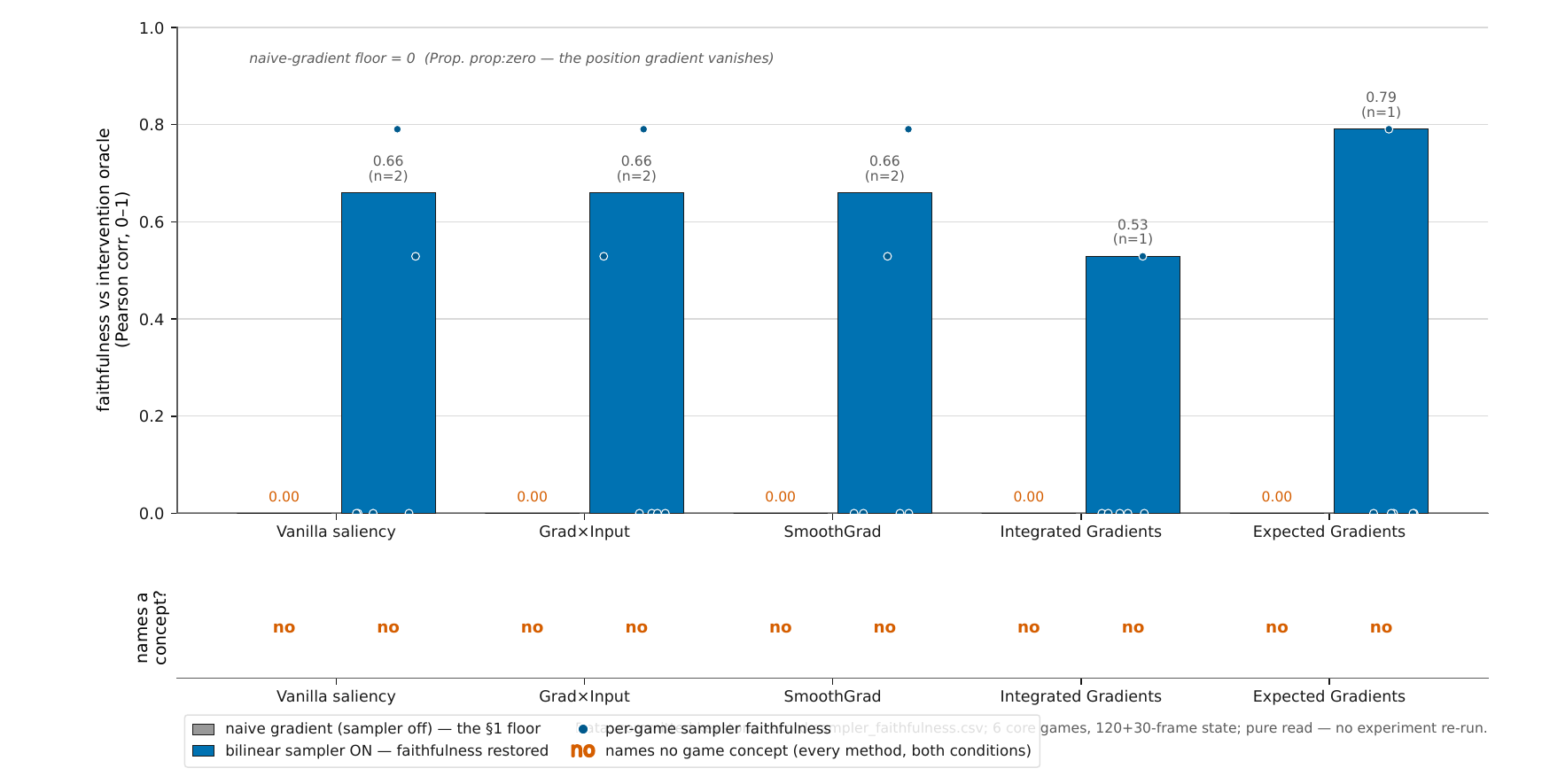
Because the VCS is fully known and exactly intervenable, every explanation can be scored against ground truth. An oracle measures the true causal effect of each state variable; XAI and mechanistic-interpretability methods are then graded by how well they recover it. Headline finding: across all regimes, causal/intervention methods stay well above gradient and correlational methods — a robust faithfulness gap of 0.321 (causal/intervention 0.705 vs gradient/correlational 0.384). On the discrete sprite-position outputs the naive gradient is exactly zero; the emulator's bilinear sampler restores a non-zero position gradient, but its faithfulness stays low, so gradient/correlational methods still collapse there while causal/intervention methods do not. Bootstrapped over the 42 scored games, the position gap is now significant (mean 0.326, 95% CI [0.277, 0.375], excludes zero).
The testbed was redesigned to score every method on the same shared random-action gameplay states — see the experiment redesign note.
paper PDF · Method catalogue & execution stack → · Scoring XAI / mechanistic-interpretability methods against the exact causal truth of a known machine
Aggregated over the 42 scored games, causal/intervention methods stay well above gradient and correlational methods — a robust faithfulness gap across all regimes. On the discrete sprite-position outputs the naive gradient is exactly zero; the emulator's bilinear sampler restores a non-zero position gradient, but its faithfulness stays low, so gradient and correlational methods still collapse there. Bootstrapped over the 42 games, the position-regime gap is now significant — its 95% confidence interval excludes zero (it crossed zero at the original six games).
Primary contrast from
leaderboard.json,
surfaced through site_data.json
· headline_contrast.all_regimes (42 scored games).
Position-regime gap — now significant at n≈42 (bootstrap over games, 95% CI excludes zero):
headline_contrast.position_regime family means; significance from
the game-level bootstrap in position_bootstrap.json (n=42 games, 20 000 resamples).
The testbed was redesigned to score every method on shared random-action gameplay states — see the
experiment redesign note.
Every claim → script → command → artifact → runtime → hardware → verifying gate.
Exact causal map |Δy(u)| via clamp/resample-and-rerun; content-path gradient ∂y/∂u via the SOFT-STE substrate; a cross-check confirming the two agree. bit_exact_rerun flag set on the records.
Candidate RAM→concept maps from OCAtari/AtariARI, upgraded to causal by verify-by-intervention (does the byte actually move the framebuffer?).
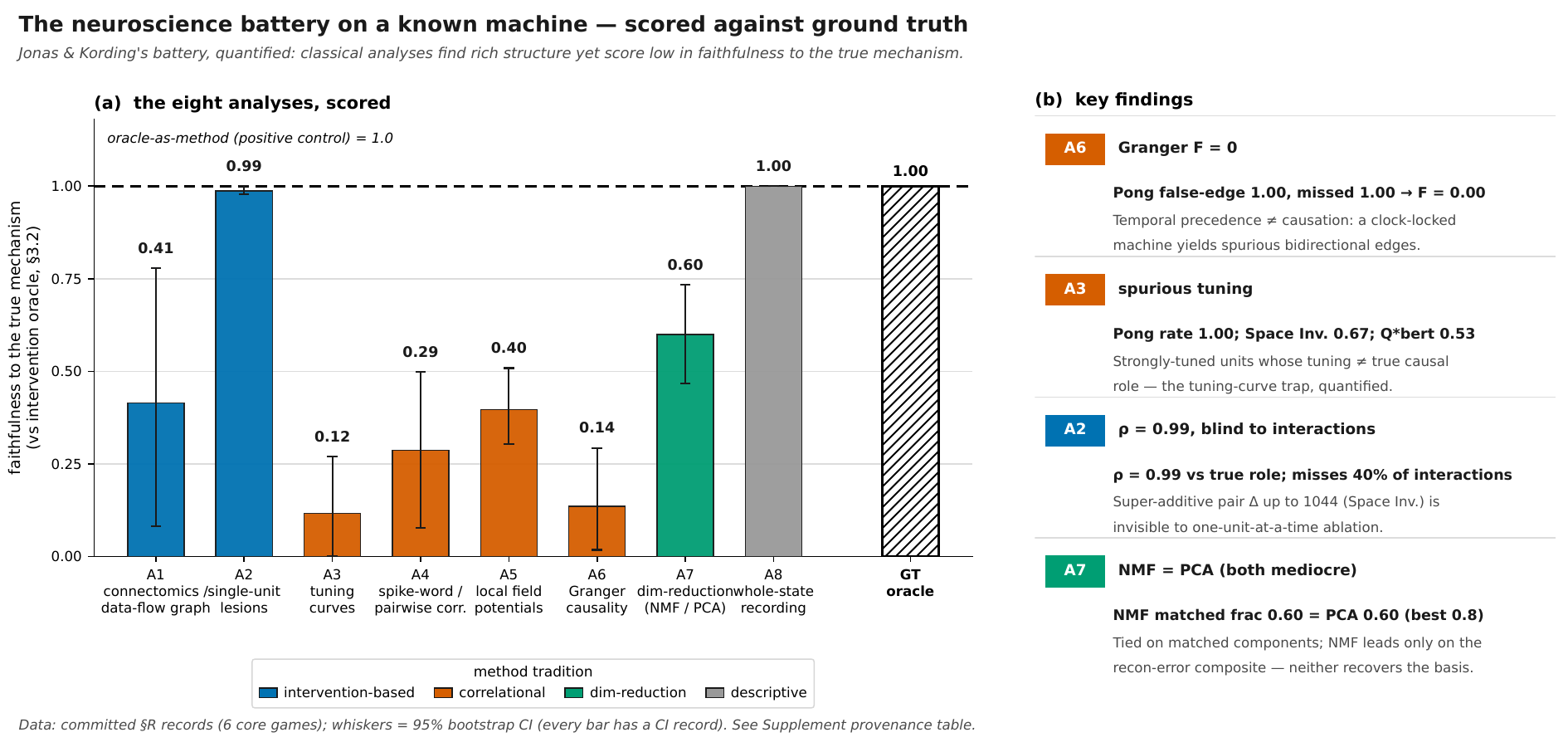
Connectomics, single-unit lesions, tuning curves, pairwise correlations, LFP spectra, Granger causality, NMF/PCA, whole-state — each scored against the true read/write graph over the 42 scored games.
Optional circuit-level (transistor) battery; product-owner-gated after the pilot. Not run for this submission — listed for honesty.
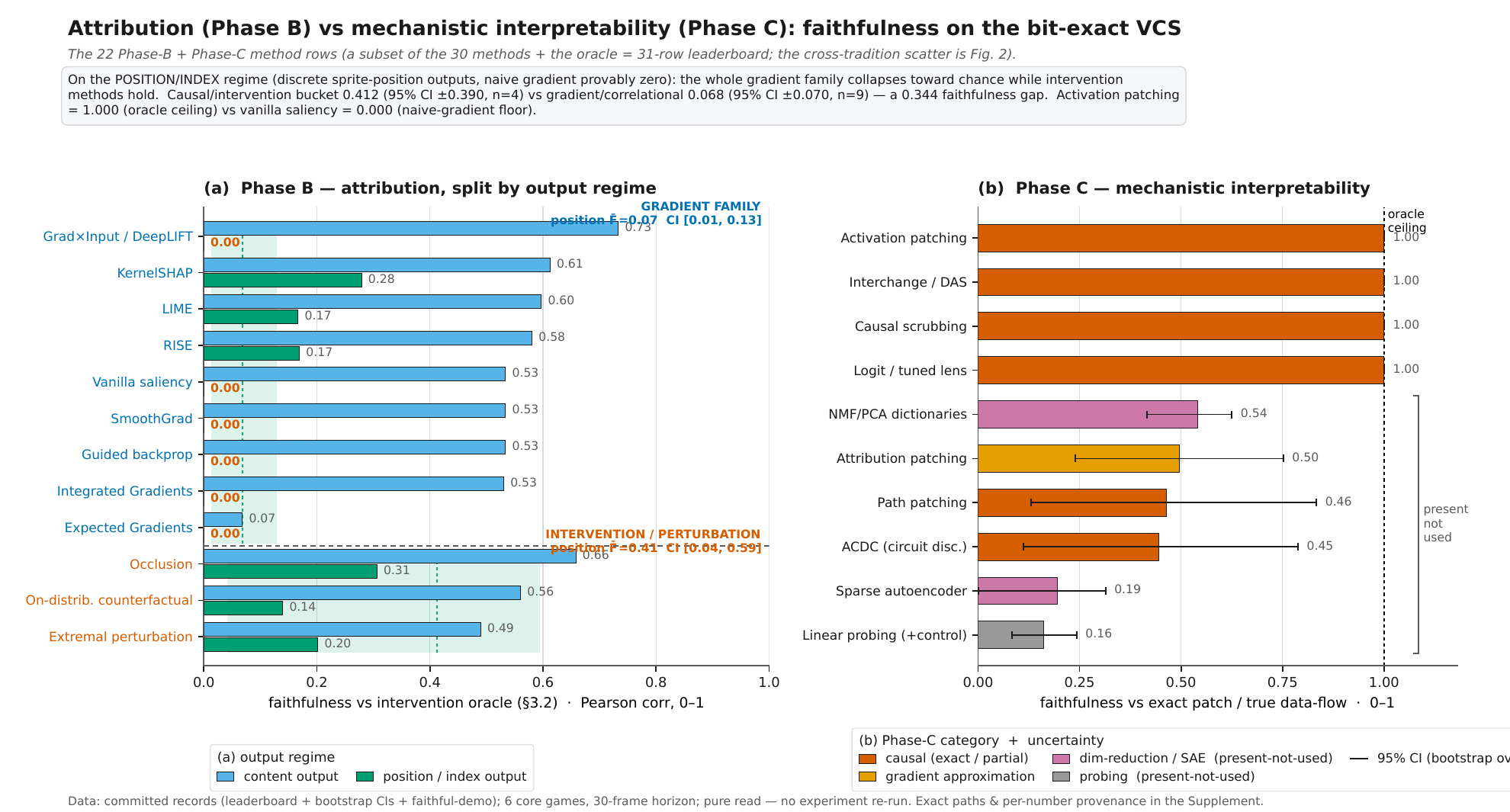
Vanilla gradient, Grad×Input, Guided Backprop, SmoothGrad, Integrated Gradients, Expected Gradients, Occlusion, extremal perturbation, RISE, LIME, KernelSHAP, counterfactual + the N/A audit — each scored by correlation and deletion/insertion AUC vs the oracle.
Every method, its reference and its implementation script are catalogued in the method & execution tour.
Activation patching / causal tracing, interchange/DAS, attribution patching, path patching, ACDC, sparse autoencoders, NMF/PCA dictionaries, causal scrubbing, linear probing + control tasks, logit/tuned lens.
Every method, its reference and its implementation script are catalogued in the method & execution tour.
Faithfulness-vs-plausibility leaderboard aggregated from every committed per-game record over the 42 scored games. Headline contrast (all regimes): causal/intervention faithfulness 0.705 vs gradient/correlational 0.384 — a robust gap of 0.321. The position-regime gap is now significant: bootstrapped over the 42 games it is 0.326 (95% CI [0.277, 0.375], excludes zero; it crossed zero at six games).
A self-contained scoring harness (magnitude_proxy demonstration) that an auditor can run with no ROM, against the committed oracle records.
Rasterised from the paper’s committed PDFs; click to enlarge.