Chan et al. 2022
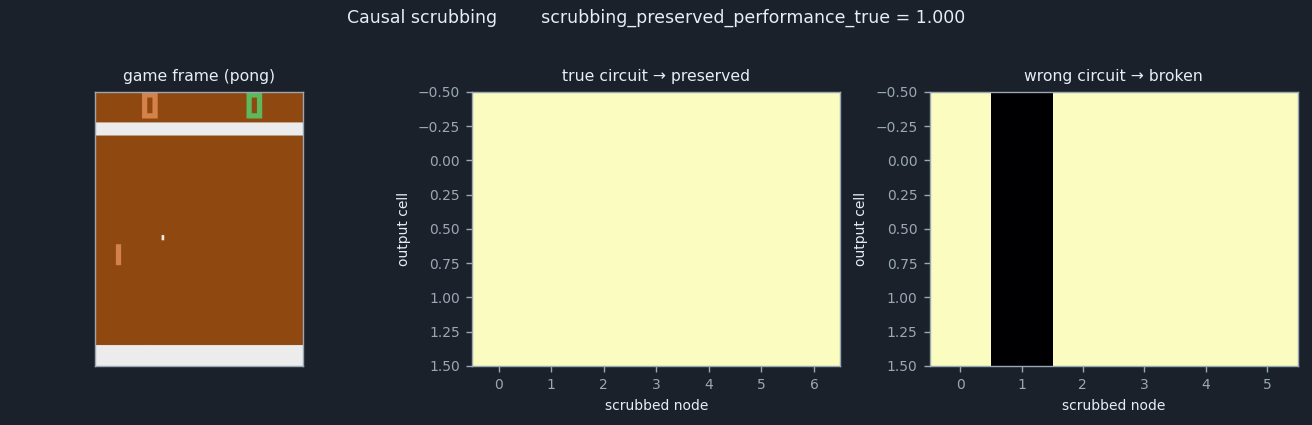
Causal scrubbing is a strict test of a circuit hypothesis. Given a claim about which parts of a system carry a computation, it resamples, or 'scrubs', everything the hypothesis says is irrelevant, replacing those signals with values from other inputs, and checks whether the behaviour still holds. If the hypothesis is correct, scrubbing the irrelevant parts should not hurt performance; if it is wrong, performance should drop. It is one of the most demanding validation methods in mechanistic interpretability, because it tests a whole hypothesis at once rather than one edge. We apply it to the VCS by resampling activations outside a hypothesised circuit and measuring whether the program's behaviour is preserved. On this machine the true data-flow hypothesis, which we know from the disassembly, passes cleanly: scrubbing everything outside it preserves the behaviour on every game, while a deliberately wrong hypothesis fails, and the two are told apart on every game. This makes causal scrubbing exact here, because the resample-and-re-run operation is a genuine intervention on a fully observable machine. As with the other exact methods, the caveat is that confirming the correct wiring is not the same as recovering what the circuit means or how its variables combine into the computed function.
The score is the behaviour preserved when resampling activations consistent with a hypothesised circuit. We scrub, that is resample, everything the hypothesis marks as irrelevant and measure whether the program's behaviour still holds. The grading is always against the intervention oracle. For the true data-flow hypothesis, which we know from the disassembly, scrubbing preserves the behaviour on every core game, so the preserved performance is at the ceiling; a deliberately wrong hypothesis fails, and the two are told apart on every game. Faithfulness for this method is that preserved-performance score, and it is exact here, because the resample-and-re-run operation is a genuine intervention on a fully observable machine. There is no sprite-position hard-case here, because the method works by intervention rather than by a gradient. The grading is a pass/fail of a whole hypothesis against the oracle, not a comparison to another method. The important qualification, which the score does not by itself capture, is that confirming the correct wiring is not the same as recovering what the circuit means or how its variables combine. The audit box reports the measured triad, with faithfulness at the ceiling on the correct hypothesis.
The score is measured against the §1 intervention oracle — never against another interpretability method. F (faithful) is always vs the oracle; see the execution stack. How each of F / S / M is actually computed for this method (and whether it matches the paper) is in the box just below; the numbers are in the In the audit box under it.
The exact formula this method uses for each score, read from its runner, and
whether it matches the paper's §3 (F ∧ S ∧ M triad) definition.
From the committed audit
fsm_math_phaseC.json.
| Axis | Formula (as computed) | What it measures | Matches §3? |
|---|---|---|---|
| F faithfulness | \(F = \dfrac{\#\{\text{true-circuit sink readouts preserved under scrub}\}}{\#\ \text{readouts}} \in [0,1]\) | For the ground-truth hypothesised circuit, the fraction of the behaviour (true-graph sink cells) preserved across the resample distribution. | ◐ partial causal_scrubbing.jl (F = clamp(true_preserved)). The hypothesis is built FROM the A1 oracle data-flow (ancestors of the output), so it is oracle-grounded, but F is a scrubbing-preservation fraction, NOT the paper's edge-F1 (circuit discovery) nor a causal-effect-agreement correlation (patching/mediation). It measures 'does the oracle-derived circuit pass the scrub' rather than 'how well does the method's discovered claim agree with the oracle'. Record: extra.triad.F / top-level value (pong F=1.0; battery mean F=0.979, n=42). how it's measured — call stack:
|
| S sufficiency | \(S = \dfrac{\#\{\text{readouts preserved (held-out resample)}\}}{\#\ \text{readouts}} \in [0,1]\) | Held-out scrubbing sufficiency; equals the F scalar here. | ✓ matches causal_scrubbing.jl (S = clamp(true_preserved)). A bit-exact-re-run preservation fraction in [0,1]; the new §3 (sec:triad) admits the fraction-within-tolerance [0,1] special case of the held-out test, which this satisfies. Record: extra.triad.S (pong S=1.0). how it's measured — call stack:
|
| M minimality | \(M = |U^{\star}| / |\hat{U}| \in (0,1]\quad U^{\star}=\{u:\Delta y(u)>0\},\ \hat{U}=\{u:|\mathrm{attr}(u)|>\tau\}\) | Oracle-mover cells over the number of cells the hypothesised circuit names. | ✓ matches causal_scrubbing.jl now emits M = |U*|/|U_hat| with U_hat = the named circuit cells (M_note '|U*|=4 (oracle movers) / |U_hat|=6 (method above-threshold) (CELL-valued hypothesis)'), the paper's set-size ratio. Record: extra.triad.M (pong M=0.667). Replaced the former candidate-cell-denominator ratio. how it's measured — call stack:
|
✓ matches = the same quantity as §3; ◐ partial = the same kind of estimator but a differing detail; ✗ does not match = a different quantity (see the note). Definitions: F = agreement with the oracle's true causal effects Δy(u); S = held-out predictive score in [−1, 1]; M = |U*|/|Û| (true-minimal-set size / named-set size).
This is the method's entry in the actual cross-method audit — scored on the paper's correctness triad, each axis a mean over all 42 scored games (42 committed §R records), not the single example shown above. Tradition: causal. The example figure (Pong) is one of those records.
F faithfulness (scored vs the oracle for every method) · S sufficiency (held-out predictive score in [−1, 1]; a negative value means the explanation predicts held-out interventions worse than the unperturbed baseline; reported for the predictive methods across all three phases where the calibration/held-out split is defined) · M minimality (true-minimal-set / named-set; where the method names a cause set) — n/a otherwise, per the paper's F ∧ S ∧ M triad.
Source: leaderboard.json · the whole leaderboard is on the
methods page and the
Paper 2 audit.
This method's faithfulness on each of the 42 scored games (all-regime F; this method has no content-vs-position split (see the note below)). Click a header to
sort. Every number is read from site_data.json
(methods.causal_scrubbing.per_game).
content-F and position-F are n/a for this method. The content-vs-position split applies only to pixel-attribution methods — those that produce an attribution map over the framebuffer, whose score can be read separately on the smooth content outputs and the discrete position outputs (where the naive gradient is provably zero). This method does not attribute to a pixel output; it is graded by its own fidelity metric (scrubbing_preserved_performance_true), reported as the F column, so there is no content or position regime to separate.
M is n/a on 1 of these games. Minimality is M = |U*|/|Û|, the size of the true minimal cause set over the size of the set the method actually names. On a game where the method names nothing (|Û| = 0 — it discovers no circuit, its attribution map is all-zero, or it decodes no cell), that ratio is undefined, so M is left blank rather than scored. The aggregate M is the mean over the 41 games where the method did name a cause set.
| Game | F (all) | content-F | position-F | S | M | Note |
|---|---|---|---|---|---|---|
| Air Raid | 1.000 | n/a | n/a | 1.000 | 1.000 | recovers the true causes |
| Alien | 1.000 | n/a | n/a | 1.000 | 1.000 | recovers the true causes |
| Assault | 1.000 | n/a | n/a | 1.000 | 0.778 | recovers the true causes |
| Atlantis | 1.000 | n/a | n/a | 1.000 | 1.000 | recovers the true causes |
| Bank Heist | 1.000 | n/a | n/a | 1.000 | 1.000 | recovers the true causes |
| Beam Rider | 1.000 | n/a | n/a | 1.000 | 1.000 | recovers the true causes |
| Berzerk | 1.000 | n/a | n/a | 1.000 | 0.875 | recovers the true causes |
| Bowling | 1.000 | n/a | n/a | 1.000 | 1.000 | recovers the true causes |
| Boxing | 1.000 | n/a | n/a | 1.000 | 1.000 | recovers the true causes |
| Breakout | 1.000 | n/a | n/a | 1.000 | 0.667 | recovers the true causes |
| Carnival | 1.000 | n/a | n/a | 1.000 | 0.667 | recovers the true causes |
| Centipede | 1.000 | n/a | n/a | 1.000 | 0.500 | recovers the true causes |
| Chopper Command | 1.000 | n/a | n/a | 1.000 | 0.286 | recovers the true causes |
| Demon Attack | 1.000 | n/a | n/a | 1.000 | 0.667 | recovers the true causes |
| Fishing Derby | 1.000 | n/a | n/a | 1.000 | 1.000 | recovers the true causes |
| Freeway | 1.000 | n/a | n/a | 1.000 | 1.000 | recovers the true causes |
| Frostbite | 1.000 | n/a | n/a | 1.000 | 1.000 | recovers the true causes |
| Gopher | 1.000 | n/a | n/a | 1.000 | 1.000 | recovers the true causes |
| Hero | 1.000 | n/a | n/a | 1.000 | 0.600 | recovers the true causes |
| Ice Hockey | 1.000 | n/a | n/a | 1.000 | 0.900 | recovers the true causes |
| Jamesbond | 1.000 | n/a | n/a | 1.000 | 0.500 | recovers the true causes |
| Kangaroo | 1.000 | n/a | n/a | 1.000 | 0.750 | recovers the true causes |
| Krull | 1.000 | n/a | n/a | 1.000 | 1.000 | recovers the true causes |
| Kung-Fu Master | 1.000 | n/a | n/a | 1.000 | n/a | recovers the true causes |
| Montezuma's Revenge | 1.000 | n/a | n/a | 1.000 | 0.875 | recovers the true causes |
| Ms. Pac-Man | 1.000 | n/a | n/a | 1.000 | 0.947 | recovers the true causes |
| Name This Game | 1.000 | n/a | n/a | 1.000 | 1.000 | recovers the true causes |
| Pacman | 1.000 | n/a | n/a | 1.000 | 0.500 | recovers the true causes |
| Phoenix | 1.000 | n/a | n/a | 1.000 | 0.500 | recovers the true causes |
| Pitfall | 1.000 | n/a | n/a | 1.000 | 0.667 | recovers the true causes |
| Pong | 1.000 | n/a | n/a | 1.000 | 0.667 | recovers the true causes |
| Q*bert | 1.000 | n/a | n/a | 1.000 | 0.500 | recovers the true causes |
| Riverraid | 1.000 | n/a | n/a | 1.000 | 0.917 | recovers the true causes |
| Road Runner | 1.000 | n/a | n/a | 1.000 | 0.889 | recovers the true causes |
| Seaquest | 1.000 | n/a | n/a | 1.000 | 0.786 | recovers the true causes |
| Space Invaders | 1.000 | n/a | n/a | 1.000 | 0.700 | recovers the true causes |
| Tennis | 1.000 | n/a | n/a | 1.000 | 0.778 | recovers the true causes |
| Venture | 1.000 | n/a | n/a | 1.000 | 0.929 | recovers the true causes |
| Video Pinball | 1.000 | n/a | n/a | 1.000 | 1.000 | recovers the true causes |
| Yars' Revenge | 1.000 | n/a | n/a | 1.000 | 0.714 | recovers the true causes |
| Private Eye | 0.890 | n/a | n/a | 0.890 | 0.818 | recovers the true causes |
| Double Dunk | 0.235 | n/a | n/a | 0.235 | 1.000 |
The path from this method's runner (run_game) into the bit-exact VCS substrate, and the
computation it involves. Every step links to the exact source on main. From
callstack_phaseC.json.
env_reset!(env; boot_noop_steps = 60, boot_reset_steps = 4) jutarienv_step!(env::StellaEnvironment, action::Integer) jutaribuild_shared_testbed(game; ... intervene_ram = intervene_ram!, run_intervention = run_intervention, soft_ram_peek = soft_ram_peek, ...) runnersnapshot(env::StellaEnvironment, frame::Integer) jutariresample_values(at_target::Snapshot, cand_idx::Vector{Int}, k::Int) runnerscrub_assign(base_ckpt, tail, cand_idx, circuit, assign) -> intervene_ram! runner intervene_ram! @ causal_scrubbing.jl:294; performance-preserved compared TRUE vs WRONG circuit hypothesestrue_dataflow_graph(base_ckpt, tail, cand_idx, at_target) -> intervene_ram!; ancestors(A, out) runner ancestors @ :245Scored against the exact intervention oracle Δy(u): run_intervention(checkpoint, actions, target_frame, horizon, cause).
The figure is generated from the committed record by
docs/gen_method_figures.py; the game frame
and each RAM cell's screen footprint are produced by
render_scenes.jl /
cell_footprints.jl.