Nanda 2023; Syed et al. 2023
Attribution patching is a fast, gradient-based approximation to activation patching. Exact patching requires a separate re-run for every internal value tested, which is expensive on a large network. Attribution patching instead uses a first-order, linear estimate: it multiplies the gradient at each site by the change that patching would apply, to predict the patch's effect in a single backward pass. This lets researchers screen thousands of sites at once, at industrial scale, and only re-run the exact patch on the promising ones. We apply it to the VCS by forming the gradient-linear estimate of each site's patch effect and comparing it to the exact effect the oracle measures. The comparison is unusually clean here because we have the exact answer for every site. The linear surrogate keeps the edges precise: it is usually right about which dependencies exist, because a real edge tends to have a non-zero gradient. What it gets wrong is the size of an edge, since the true relationship is not linear, so its numerical agreement with the exact patch is only partial. Attribution patching is therefore a good cheap screen with a measurable error, and the VCS lets us quantify exactly how much accuracy the approximation trades away for its speed.
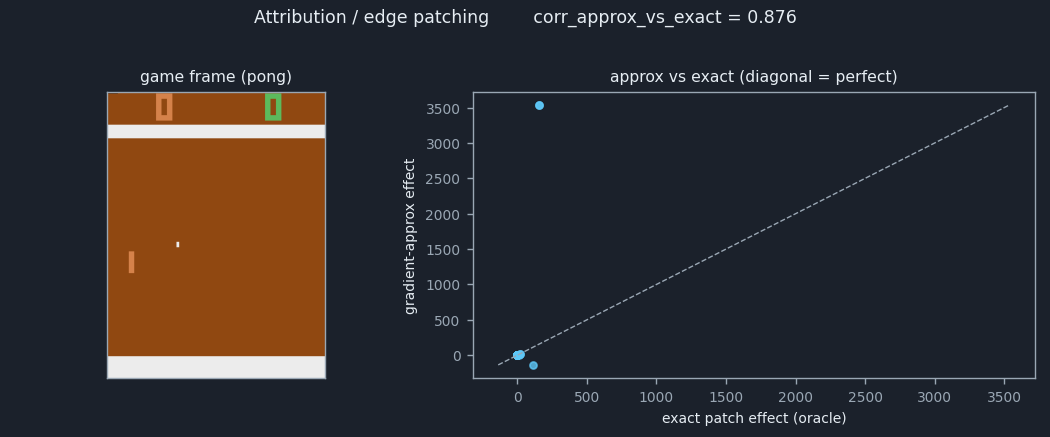
Each point is one intervention site: its exact causal effect from the oracle (x) against the method's recovered/approximate effect (y). Points on the dashed diagonal mean the method recovered the true effect. corr_approx_vs_exact = 0.876 — this example only (pong, state gameplay(seed=0,prefix=90)+15); the audit aggregate is below.
The score is the Pearson correlation between the gradient-approximate patch effect and the exact patch effect from the oracle. The grading is always against the intervention oracle. Attribution patching forms a first-order, linear estimate of each site's patch effect in a single backward pass, so we can compare that estimate directly to the exact effect the oracle measures at the same site. Faithfulness for this method is that correlation, and it is good but not perfect, because the true relationship is not linear. The linear surrogate keeps the edges precise: it is usually right about which dependencies exist, since a real edge tends to have a non-zero gradient, so edge precision and recall stay high. What it gets wrong is the size of an edge, which is why the numerical agreement with the exact patch is only partial. There is no sprite-position collapse framed as such here, because the method is scored on internal patch effects rather than on a rendered position; but its gradient origin is exactly why it approximates rather than matches. The grading is always against the oracle. The audit box reports the measured triad, so the correlation is an average across the scored games, quantifying how much accuracy the fast approximation trades away for its speed.
The score is measured against the §1 intervention oracle — never against another interpretability method. F (faithful) is always vs the oracle; see the execution stack. How each of F / S / M is actually computed for this method (and whether it matches the paper) is in the box just below; the numbers are in the In the audit box under it.
The exact formula this method uses for each score, read from its runner, and
whether it matches the paper's §3 (F ∧ S ∧ M triad) definition.
From the committed audit
fsm_math_phaseC.json.
| Axis | Formula (as computed) | What it measures | Matches §3? |
|---|---|---|---|
| F faithfulness | \(F = \rho_{\mathrm{Pearson}}\!\left(\hat{\Delta y}(u),\ \Delta y(u)\right)\) | Pearson correlation between the first-order attribution-patching approximation of each patch effect and the exact re-run patch effect. | ✓ matches attribution_patching.jl (F = clamp(r.corr,0,1)); metric_name corr_approx_vs_exact. This is the paper's Phase-C patching F = causal-effect-agreement correlation vs Delta_y(u). Record: extra.triad.F (attribution_patching_pong.json F=0.876; battery mean F=0.456, n=42). how it's measured — call stack:
|
| S sufficiency | \(S = \dfrac{\#\{\,u_{\mathrm{held}}:\ |\hat{y}-y|\le\varepsilon\,\}}{|\mathrm{held\text{-}out}|}\in[0,1]\) | Same shared held-out predictive sufficiency estimator as activation_patching. | ✓ matches common/triad_sm.jl sufficiency_score via triad_extra_dict (attribution_patching.jl). Paper-conform. Record: extra.triad.S (pong S=0.973; battery mean S=0.769, n=42). how it's measured — call stack:
|
| M minimality | \(M = |U^{\star}| / |\hat{U}| \in (0,1]\quad U^{\star}=\{u:\Delta y(u)>0\},\ \hat{U}=\{u:|\mathrm{attr}(u)|>\tau\}\) | True minimal cause set over method-named (above-threshold) set. | ✓ matches common/triad_sm.jl minimality_score. Paper-conform. Record: extra.triad.M (pong |U*|=6/|U_hat|=5, M=1.0; battery mean M=0.995, n=42). how it's measured — call stack:
|
✓ matches = the same quantity as §3; ◐ partial = the same kind of estimator but a differing detail; ✗ does not match = a different quantity (see the note). Definitions: F = agreement with the oracle's true causal effects Δy(u); S = held-out predictive score in [−1, 1]; M = |U*|/|Û| (true-minimal-set size / named-set size).
This is the method's entry in the actual cross-method audit — scored on the paper's correctness triad, each axis a mean over all 42 scored games (42 committed §R records), not the single example shown above. Tradition: gradient. The example figure (Pong) is one of those records.
F faithfulness (scored vs the oracle for every method) · S sufficiency (held-out predictive score in [−1, 1]; a negative value means the explanation predicts held-out interventions worse than the unperturbed baseline; reported for the predictive methods across all three phases where the calibration/held-out split is defined) · M minimality (true-minimal-set / named-set; where the method names a cause set) — n/a otherwise, per the paper's F ∧ S ∧ M triad.
Source: leaderboard.json · the whole leaderboard is on the
methods page and the
Paper 2 audit.
This method's faithfulness on each of the 42 scored games (all-regime F; this method has no content-vs-position split (see the note below)). Click a header to
sort. Every number is read from site_data.json
(methods.attribution_patching.per_game).
content-F and position-F are n/a for this method. The content-vs-position split applies only to pixel-attribution methods — those that produce an attribution map over the framebuffer, whose score can be read separately on the smooth content outputs and the discrete position outputs (where the naive gradient is provably zero). This method does not attribute to a pixel output; it is graded by its own fidelity metric (corr_approx_vs_exact), reported as the F column, so there is no content or position regime to separate.
| Game | F (all) | content-F | position-F | S | M | Note |
|---|---|---|---|---|---|---|
| Yars' Revenge | 1.000 | n/a | n/a | 0.983 | 1.000 | recovers the true causes |
| Kung-Fu Master | 1.000 | n/a | n/a | 0.976 | 1.000 | recovers the true causes |
| Berzerk | 1.000 | n/a | n/a | 0.958 | 1.000 | recovers the true causes |
| Centipede | 1.000 | n/a | n/a | 0.976 | 1.000 | recovers the true causes |
| Kangaroo | 0.999 | n/a | n/a | 0.927 | 1.000 | recovers the true causes |
| Carnival | 0.998 | n/a | n/a | 0.951 | 1.000 | recovers the true causes |
| Tennis | 0.986 | n/a | n/a | 0.927 | 1.000 | recovers the true causes |
| Hero | 0.960 | n/a | n/a | 0.962 | 1.000 | recovers the true causes |
| Breakout | 0.936 | n/a | n/a | 0.952 | 1.000 | recovers the true causes |
| Venture | 0.909 | n/a | n/a | 0.000 | 1.000 | recovers the true causes |
| Pong | 0.876 | n/a | n/a | 0.973 | 1.000 | recovers the true causes |
| Pitfall | 0.790 | n/a | n/a | 0.918 | 1.000 | |
| Video Pinball | 0.769 | n/a | n/a | 0.909 | 1.000 | |
| Riverraid | 0.654 | n/a | n/a | 0.960 | 1.000 | |
| Ms. Pac-Man | 0.645 | n/a | n/a | 0.943 | 1.000 | |
| Montezuma's Revenge | 0.567 | n/a | n/a | 0.957 | 1.000 | |
| Atlantis | 0.493 | n/a | n/a | 0.952 | 1.000 | |
| Bank Heist | 0.463 | n/a | n/a | 0.042 | 1.000 | |
| Private Eye | 0.444 | n/a | n/a | 0.954 | 1.000 | |
| Road Runner | 0.434 | n/a | n/a | 0.012 | 0.778 | |
| Assault | 0.408 | n/a | n/a | 0.978 | 1.000 | |
| Pacman | 0.371 | n/a | n/a | 0.054 | 1.000 | |
| Space Invaders | 0.360 | n/a | n/a | 0.962 | 1.000 | |
| Ice Hockey | 0.310 | n/a | n/a | 0.891 | 1.000 | |
| Air Raid | 0.263 | n/a | n/a | 0.967 | 1.000 | |
| Chopper Command | 0.257 | n/a | n/a | 0.978 | 1.000 | |
| Gopher | 0.232 | n/a | n/a | 0.978 | 1.000 | |
| Freeway | 0.198 | n/a | n/a | 0.891 | 1.000 | |
| Fishing Derby | 0.183 | n/a | n/a | 0.952 | 1.000 | |
| Seaquest | 0.178 | n/a | n/a | 0.952 | 1.000 | |
| Jamesbond | 0.174 | n/a | n/a | 0.917 | 1.000 | |
| Phoenix | 0.131 | n/a | n/a | 0.909 | 1.000 | |
| Krull | 0.082 | n/a | n/a | 0.965 | 1.000 | |
| Double Dunk | 0.059 | n/a | n/a | 0.036 | 1.000 | |
| Frostbite | 0.031 | n/a | n/a | 0.943 | 1.000 | no true-cause signal |
| Q*bert | 0.006 | n/a | n/a | 0.000 | 1.000 | no true-cause signal |
| Alien | 0.000 | n/a | n/a | 0.893 | 1.000 | no true-cause signal |
| Beam Rider | 0.000 | n/a | n/a | 0.000 | 1.000 | no true-cause signal |
| Bowling | 0.000 | n/a | n/a | 0.945 | 1.000 | no true-cause signal |
| Boxing | 0.000 | n/a | n/a | 0.941 | 1.000 | no true-cause signal |
| Demon Attack | 0.000 | n/a | n/a | 0.913 | 1.000 | no true-cause signal |
| Name This Game | 0.000 | n/a | n/a | 0.000 | 1.000 | no true-cause signal |
The path from this method's runner (run_game) into the bit-exact VCS substrate, and the
computation it involves. Every step links to the exact source on main. From
callstack_phaseC.json.
env_reset!(env; boot_noop_steps = 60, boot_reset_steps = 4) jutarienv_step!(env::StellaEnvironment, action::Integer) jutaribuild_shared_testbed(game; ... run_intervention = run_intervention, soft_ram_peek = soft_ram_peek, ...) via build_attr_shared_state runnersnapshot(env::StellaEnvironment, frame::Integer) jutarisite_gradient(...) -> snap_hi = run_patch(...hi); snap_lo = run_patch(...lo); (read(snap_hi)-read(snap_lo))/denom runner gradient surrogate over the true patch run_patch (activation_patching.jl:282)ex_snap = run_patch(clean_ckpt, tail, p.kind, p.site, p.value) runner ex_snap @ :352; linear-probe positive control @ linear_probe :481_st_sampler_position_read(ram, geom, cell; soft_ram_peek) -> soft_ram_peek(ram, pidx) runner soft_ram_peek definition @ jutari/src/diff/SoftStep.jl:108Scored against the exact intervention oracle Δy(u): run_intervention(checkpoint, actions, target_frame, horizon, cause).
On jaxtari (JAX / GPU): the same differentiable path has a bit-exact JAX sibling (Theorem 1, forward-exact) for batched GPU runs — jaxtari/jaxtari/diff/soft_step.py (soft_ram_peek @ line 102) — the JAX SOFT-STE gradient path, forward-bit-exact to the HARD jutari map. attribution_patching is the ONLY Phase-C method with a gradient step; its sampler-aware position gradient routes through soft_ram_peek (jutari/src/diff/SoftStep.jl:108), whose JAX sibling is this file.
The figure is generated from the committed record by
docs/gen_method_figures.py; the game frame
and each RAM cell's screen footprint are produced by
render_scenes.jl /
cell_footprints.jl.